
- Home
- Our Story
- Milestones
- Resources
Press Releases
Publications
- Support Us
- Home
- Our Story
- Milestones
- Resources
Press Releases
Publications
- Support Us
- Home
- Our Story
- Milestones
- Resources
Press Releases
Publications
- Support Us

The Foundation for Economic Freedom (FEF) proposed a new legal approach for forestry-based carbon projects on public forest lands by treating them as non-extractive environmental services rather than as leases or conventional arrangements for natural resource utilization.
In FEF’s study, “A Legal Framework for the Regulation of Forest Carbon as a Non-Extractive Environmental Service,” presented to officials of the Department of Environment and Natural Resources (DENR) headed by Undersecretary Analiza Rebuelta-Teh on March 10, 2026, the legal nature of carbon rights and carbon credits was discussed and how clarifying this would help complement and strengthen the government’s rules on forest carbon projects.
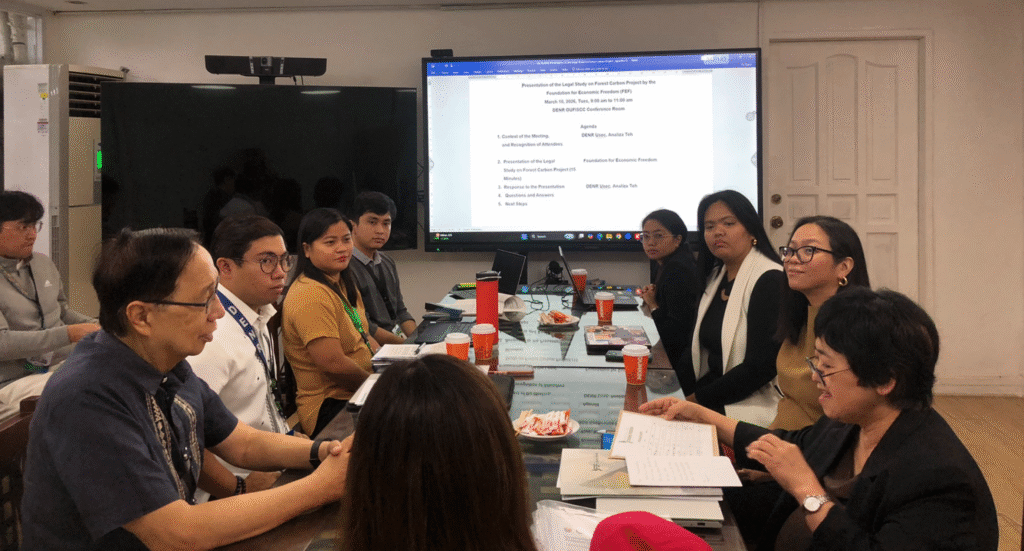
FEF’s study identifies a legal uncertainty that, if left unresolved, could later delay the development of forestry-based carbon projects in the Philippines.
Existing legal frameworks, such as the Public Land Act and Revised Forestry Code, were primarily designed around public land disposition, resource utilization, and extractive activities. Forest carbon projects, however, operate on a fundamentally different premise: their economic and environmental value arises from maintaining, restoring, and protecting forests, not from cutting trees or extracting resources.
This mismatch, FEF said, creates significant confusion and uncertainty. If forest-based carbon projects on forest lands are treated as leases of public domain land, they may be subject to the usual 25-year period, renewable once, even though carbon projects often require longer periods to meet carbon permanence, monitoring, and verification requirements. Furthermore, treating them as forms of natural resource exploitation could bring them within the constitutional restrictions governing the exploration, development, and utilization of natural resources. This includes nationality restrictions, even where no ownership, possession, or control over public land or forest resources is transferred.
This lack of clarity, FEF said, discourages investment and limits the entry of long-term financing, technical expertise, and private-sector innovation into forest conservation and climate mitigation efforts. It also weakens the country’s ability to mobilize private capital for the restoration of barren and degraded forest lands.
FEF’s study explains that the key to resolving this regulatory ambiguity is to correctly identify the legal nature of both carbon credits and forestry-based carbon projects.
The study maintains that carbon credits are not natural resources. Unlike timber, minerals, or petroleum, carbon credits are not physical resources found in or extracted from the land.
A carbon credit comes into existence only after a verified emissions reduction or carbon removal has been measured, independently validated, and formally issued through an authorized registry. It is therefore an intangible, registry-based regulatory instrument that represents verified environmental performance.
In simple terms, a tree exists in nature, but a carbon credit exists only after the required legal, scientific, and administrative processes have been completed. Its value arises from verified environmental performance and compliance with regulatory standards, not from the physical appropriation of the forest.
FEF’s study points to this critical distinction. Because carbon credits are not natural resources, their generation, ownership, and transfer do not, by themselves, constitute the exploration, development, or utilization of natural resources under Article XII of the 1987 Constitution.
FEF’s study likewise maintains that properly structured forest carbon projects on public forest lands should not be treated as leases.
A lease ordinarily involves the transfer of possession and beneficial enjoyment of property to a private party for productive use. Forest carbon projects perform the opposite. The project proponent is prohibited from exploiting the forest and is instead required to protect, restore, monitor, and maintain it.
A contractor is hired to maintain or secure a government building. Such a contractor may enter the premises and perform activities necessary to fulfill its obligations, but those activities do not make the contractor a lessee of the building. The presence is tied solely to the performance of a service, while ownership, possession, and control remain with the owner of the building, the government.
The same principle applies to forest carbon projects. A proponent’s presence on public forest land is incidental to the environmental services it is engaged to perform. It does not confer ownership or juridical possession of the land, nor does it authorize the proponent to harvest timber, convert the land, or appropriate other natural resources.
Throughout the project, the State retains ownership and control over public forest lands, including the authority to supervise activities, impose corrective measures, and suspend or terminate the project for non-compliance.
Treating these arrangements as leases would therefore confuse the place where the environmental service is performed with the legal object of the arrangement. The forest is the site of the service, not property transferred to the project proponent for its private use or enjoyment.
The study also examines the implications of foreign participation in forestry-based carbon projects.
Foreign participation in forest carbon projects does not automatically trigger the Constitution’s nationality restrictions, which apply to land ownership and the exploitation of natural resources. Foreign entities may contribute financing, technology, technical expertise, project development, verification services, or purchase carbon credits without acquiring ownership or control over Philippine land or natural resources. As long as they are not granted possessory, extractive, or proprietary rights, their role is limited to providing regulated environmental services or acquiring registry-issued carbon credits rather than engaging in natural resource utilization.
To provide greater legal certainty while preserving the State’s authority over public forest lands, FEF’s study recommends that the DENR establish an administrative mechanism through a new regulatory instrument as the appropriate legal instrument for forestry-based carbon projects.
The proposed instrument would:
FEF emphasizes that its proposal does not call for the government to surrender control over public forest lands. On the contrary, the proposed framework would strengthen State oversight by clearly separating permission to perform a regulated environmental service from the grant of land tenure or natural resource rights.
FEF believes that forest carbon projects should be governed according to their non-extractive nature. They protect forests, restore ecosystems, reduce greenhouse gas emissions, and generate verified environmental benefits.
A properly designed regulatory framework can preserve the State’s full ownership and control over public forest lands while providing greater legal certainty for project proponents and communities. It can also mobilize private financing for forest protection and restoration, create livelihood opportunities in rural communities, and help the Philippines meet its climate commitments.
Taken together, recognizing forest carbon as a non-extractive environmental service allows the government to establish a clearer path for responsible investment and innovation while upholding constitutional safeguards, environmental integrity, and the rights of local and Indigenous communities.
by Christian Dave Anda, Program Coordinator